
Why in News?
- Recently, the Union Ministry of Health and Family Welfare (MoH&FW) pulled up at least twenty companies including Tata-1mg, Flipkart, Apollo, PharmEasy, for selling medicines online.
- This happened after the All-India Organisation of Chemists and Druggists (AIOCD), a powerful lobby of over 12 lakh pharmacists, threatened to launch a country-wide agitation if the government didn’t act.
.jpeg)
What’s in Today’s Article?
- What is the Legislative Framework for e-Pharmacies in India?
- How are e-Pharmacies Competing with Chemist Shops?
- Is Banning e-Pharmacies a Viable Option?
- What Lies Ahead - A hybrid Model of e-Pharmacies and Brick and Mortar Stores?
What is the Legislative Framework for e-Pharmacies in India?
- As of now, no exact rules are in place for E-drug stores in India, and this is a significant inhibitor to the online drug store market in India.
- At present, E-pharmacies in India follow the Drugs and Cosmetics Act 1940, the Drugs and Cosmetics Rules 1945, the Pharmacy Act 1948 and the Indian Medical Act 1956.
- However, the electronic sale of physician-prescribed drugs from online drug store sites is expressed under the IT Act, 2000.
- E-pharmacies are managed by state drug controllers and approvals for E-pharmacies should be given by the Drug Controller General of India (DCGI).
- The MoH&FW in 2018 came out with draft rules to control the online offer of medications and availability of genuine drugs from certifiable online sites.
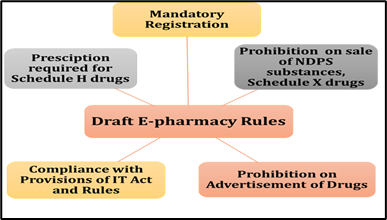
- But, after being sent to a group of ministers, the proposal was immediately put on hold.
- Since then, multiple court orders and the 172nd Parliamentary Standing Committee report have called for regulating e-pharmacies.
- An administrative structure to oversee/regulate the e-pharmacy sector is necessary when antimicrobial resistance (AMR), criminal and risky movement of drugs, is on the rise.
How are e-Pharmacies Competing with Chemist Shops?
- Flushed with billions of dollars of private equity, e-pharmacies started offering hefty discounts on medicines in a bid to garner more market share.
- e-Pharmacies call themselves facilitate doorstep delivery.
- Companies like PharmEasy are building a supply chain from the ground up by buying out big and small wholesale drug distributors like Ascent Health, Desai Pharma, etc.
- But this aggressive growth is coming at a cost. Since 2015, e-pharmacies have recorded losses year-on-year. For example, Tata-1 Mg posted a loss of ₹146 crore in FY22.
Is Banning e-Pharmacies a Viable Option?
- The demand for online delivery of drugs is burgeoning.
- The year 2020 marked a watershed moment for the growth of e-pharmacies as it saw nearly 8.8 million households using home delivery services during lockdown.
- There is a possibility that some of these businesses will go underground if banned.
What Lies Ahead - A hybrid Model of e-Pharmacies and Brick and Mortar Stores?
- In a climate where drug delivery is driven by consumer sentiments, it is futile to stick to any one way of doing business.
- For acute care and emergency, patients still rely on their neighbourhood pharmacy stores.
- This has led e-pharmacy players to now open capital-intensive brick and mortar stores.
- Stiff competition has forced chemist shops to also offer home delivery options over their own store apps/Whatsapp.
- In an ecosystem that is moving towards a hybrid mode, all eyes are on the government which will have to effectively regulate the new way of doing e-commerce in the drug space.
Post a Comment
We welcome relevant and respectful comments. Off-topic or spam comments may be removed.